
DeepSeek open-sources dsh-superagent, a Router-Worker coding agent
DeepSeek's Harness team published dsh-superagent, a research prototype that splits a coding agent into one Router and many isolated Workers on a single GitHub repo. Its permission model is the part worth stealing.
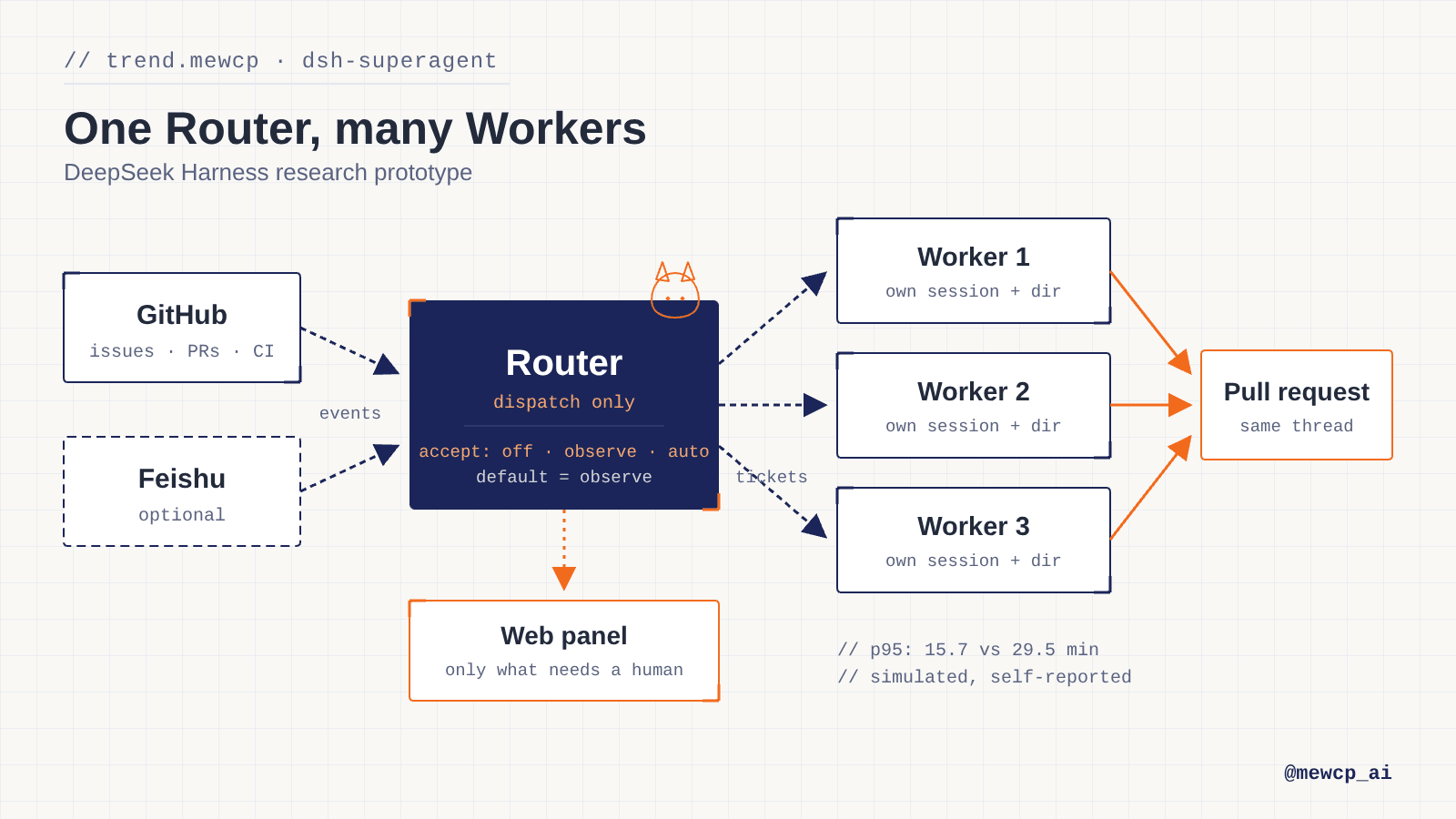
DeepSeek's Harness team released a research prototype that splits one coding agent into a dispatcher and many isolated workers, and its real argument is about your attention, not the model.
On October 31 the DeepSeek Harness team published a design essay called Exploring Super-agent Design: Towards a More Autonomous Agent System, and next to it an MIT-licensed prototype called dsh-superagent-prototype. It's not a new model. It's orchestration around the tools you already run, aimed at one GitHub repository.
A post on r/artificial walked through it and asked the right questions. It got 22 points and only 4 comments, so the reaction is thin, but the design itself is worth a proper look if you're building anything agent-shaped.
What's actually new
The core split is a Router and Workers. A persistent Router session handles incoming conversations and decides what to dispatch, but doesn't do the work itself. Each accepted work item gets its own Worker session and its own directory, so tasks run in parallel without sharing context.
The README describes the bundle as "a proactive coding agent for one GitHub repository," packaged for DeepSeek Harness. It listens to GitHub and, optionally, Feishu. When someone allowed asks for work, it opens a work item, does it in its own session and answers in the original conversation, often with a pull request. A local web panel shows only what needs a person.
MarkTechPost's write-up adds the plumbing from the design docs. Events come in from a Source as Triggers. An Eval step decides whether a batch of Triggers is actually asking for new work. Accepted work becomes a Ticket with an immutable Mandate stating why it may proceed. A Subscription routes later pull request comments straight to the Worker that owns them, so nobody has to mention the bot again. The Router runs with a smaller tool set than the Workers, and Worker shell commands move to the background after 5 seconds so they keep receiving messages.
The behaviour rules are the bit I liked most. The stated philosophy is "take as little human attention as possible, and give as much value as possible." The agent confirms once, stays quiet while working and speaks again only with a result, a question or a failure. Proactive work has three accept modes, off, observe and auto, and observe is the default. In that mode it only records what it would have done.
DeepSeek's argument is that human attention is now the bottleneck, not model capability. The team says a person can actively follow only 3 to 5 agent sessions at once.
The numbers, with the caveats
In DeepSeek's own simulated test, each run had about 300 messages, of which about 20 were real work requests, and each setup ran 5 times. The super-agent finished the slowest 5 percent of tasks in 15.7 minutes (p95), against 29.5 minutes for a single session with subagents. Its p50 was 12.4 minutes.
There's a catch in why the baseline lost though. Under the neutral prompt, the baseline called a subagent 0 times in 5 runs. So part of the gap is a single agent that never delegated. An ablation that removed direct event pass-through raised Router decisions by about 30% and cache-read tokens by about 37%, from 23.23M to 31.77M.
All of this is self-reported. The messages were synthetic, the tools were simulated, real coding quality wasn't measured and there's no verified comparison with Claude Code or Codex.
Why it matters if you build agents
Even if you never run this code, the shape is useful. One long-lived process that only routes, plus short-lived workers that each own one task and one context. Say your agent watches a repo and a team chat. A teammate asks for a bug fix while CI is failing on another branch. With one session, both threads pile into the same context and the agent loses the plot halfway through. With a Router, each becomes its own Ticket, with its own directory and its own conversation to answer.
The permission model is the other takeaway. "Acts only when an allowed person asks, or when a team-written rule permits it" is a good default for any agent that can write to shared systems.
That's also where your own setup needs work. MarkTechPost notes the prototype runs with full OS-user access, so isolate it before use. Its requirements include the GitHub CLI, which suggests it works through your local GitHub login, and a gateway only governs calls that actually pass through it. For the apps your agents reach over MCP, MewCP lets you choose which tools each agent can use, so a worker could get GitHub's create pull request tool while merge stays switched off, and anything switched off is stopped before it reaches the app. DeepSeek Harness itself has a built-in MCP client, and MewCP has a setup guide for DeepSeek Harness. We haven't tested it with the superagent bundle specifically. And if code review is the job you want covered first, there's a ready-made Review a GitHub Pull Request blueprint on the MewCP use cases page.
What people are saying
The comments on r/artificial were short and sensible. One person said the permissions are the part they'd actually trust: observe-only by default, no write access until a human says so. They'd happily point it at a side project in a sandbox with draft PRs only, but "letting it loose on a main repo with merge rights is where my nerve goes."
Another said the split makes sense to anyone who has watched a single agent trip over its own context window halfway through a task. And the sharpest pushback was about bad splits. If the Router breaks a task up badly, people end up reviewing more PRs, which kinda defeats the point of saving attention. Nobody in the thread had tried it on a real repo yet.
Sources
- dsh-superagent-prototype README, https://raw.githubusercontent.com/deepseek-ai/dsh-superagent-prototype/main/README.md
- r/artificial thread, https://www.reddit.com/r/artificial/comments/1xlc9ye/deepseek_opensources_a_superagent_coding/
- MarkTechPost, DeepSeek Open-Sources dsh-superagent, https://www.marktechpost.com/2026/11/01/deepseek-dsh-superagent-router-worker-coding-agent/
- DeepSeek Harness on X, https://x.com/DeepSeekHarness/status/2116857257245987236
- MewCP docs, How to Connect DeepSeek Harness to MewCP, https://docs.mewcp.com/mewcp/connect-agents/deepseek-harness.md
Keep reading
Related articles
MEX 0.8.5 turns coding agent explanations into checked state diagrams
MEX 0.8.5 adds a statechart skill that has Claude Code or Codex draw a flow as a state diagram, with project notes and code references attached. The useful part is what it does to recovery paths.
Context.dev raises $9M seed to give agents live web data
Context.dev raised a $9M seed led by General Catalyst for one API that searches, scrapes and monitors the web for agents. Builders on Reddit cared less about the money than about how scrapers fail.
Construct lets agents describe 3D objects instead of drawing them
An agent researches a real object and writes down what it knows, then Construct turns that into a 3D model with each part tagged by how it is known, from verified to guessed. The pattern is useful well beyond 3D.
MewCP vs Arcade: Comparing Actions Runtimes for AI Agents
A layer-by-layer comparison of MewCP and Arcade.dev, two enterprise actions runtimes that give AI agents an MCP gateway, a tool catalog, managed auth and governance, with deployment, compliance, pricing and clear advice on when each one fits.