LogicLens fact-checks video claims live with web search and an LLM
by Rohit Gite, Co-Founder @MewCP6 min read
Keep reading
Keep reading
Agent infrastructure
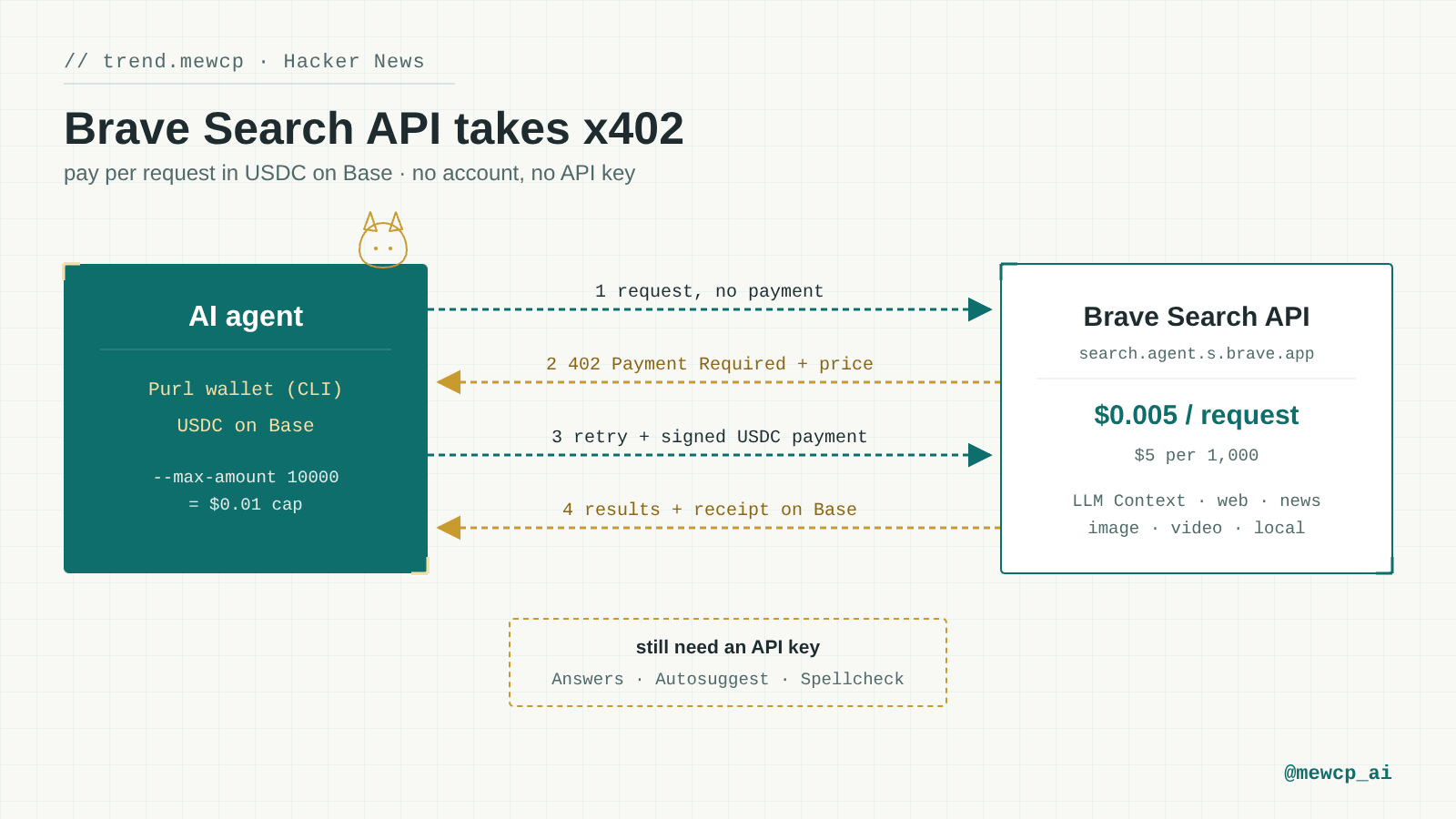
Brave now lets an agent pay $0.005 per search in USDC on Base instead of signing up for an API key. Hacker News argued over the price, the crypto rails and who will actually pay.
LogicLens pulls claims out of YouTube transcripts and checks each one against web search results before an LLM gives a verdict. Reddit's pushback on sources and intent applies to any research agent.
A developer shared a Chrome extension that fact-checks a video while it plays, and the most useful part of the Reddit thread wasn't about politics at all, it was about how a model should talk about evidence.
The post went up on r/artificial today with a demo of the extension flagging claims in a clip of Biden and Trump. It got 111 points and 30 comments. The maker says they've "embarrassingly" been working on it for two years and decided to share after seeing others post YouTube-only versions. The same post also went up on r/OpenAI.
The product is called LogicLens. It's a free Chrome extension, and there's an iPhone app that does the same job under the name Receipts. The Register wrote it up two days ago, so there's a real product behind the demo.
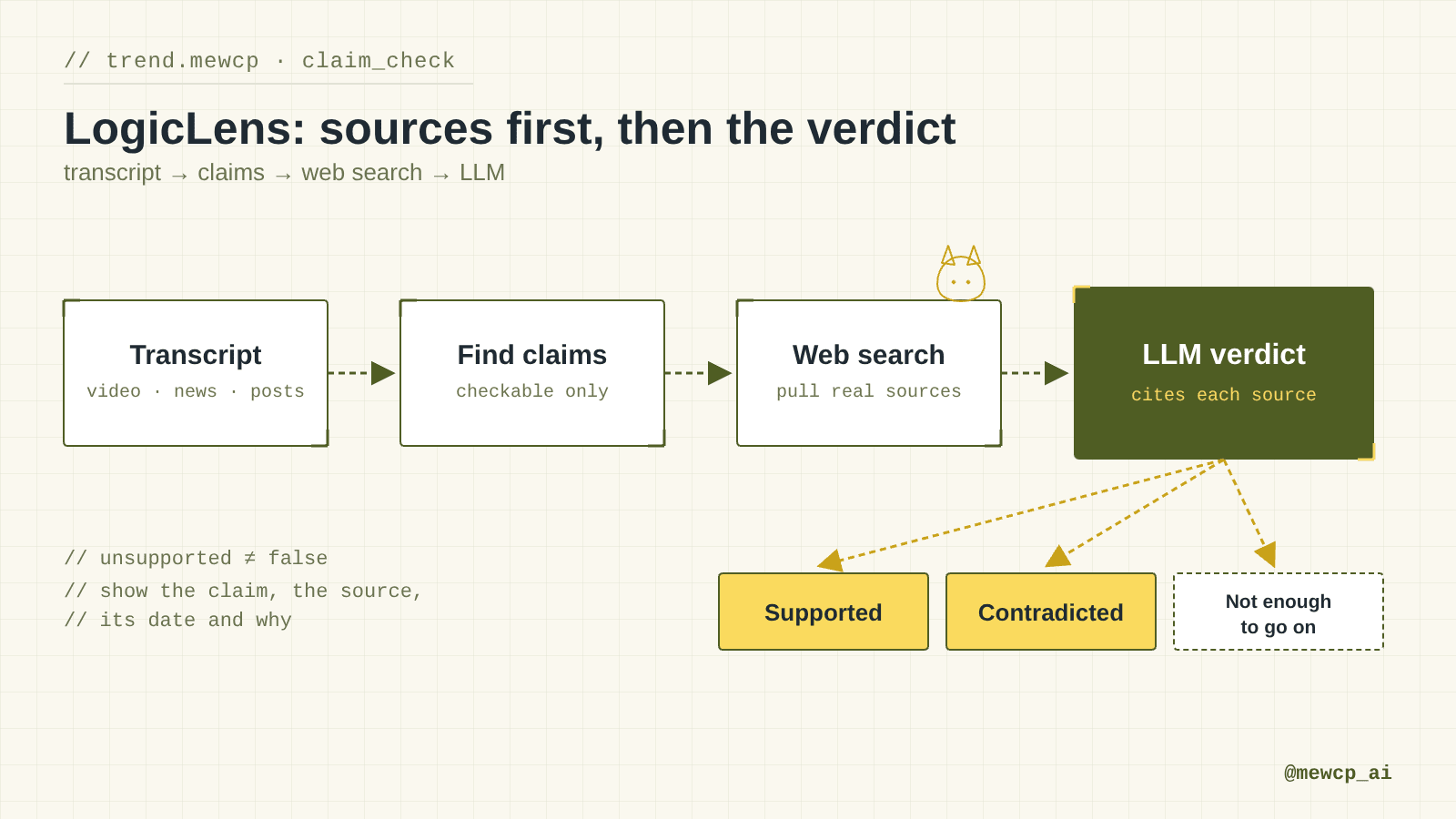
The pipeline is simple to describe and that's kinda the point. On YouTube the extension transcribes what's being said and picks out the claims that can be checked. Then web search pulls sources for each claim, and the model's verdict is based on those sources. The maker says the search step is there "to avoid hallucinated sources". It also works on news and social media sites, not only video.
What you get back is a verdict with the sources attached. The examples on the LogicLens site show labels like "Checks out", "Mixed bag" and "Doesn't check out", with each source marked as supported or contradicted. The iOS page says that if there isn't enough to go on it says so, and that it never calls opinion, satire or predictions false. In the extension a flagged claim currently shows up as a red notification.
The site also says it flags 80+ categories of persuasion tricks, like missing context and loaded language, and that its system is custom designed to outperform general models like ChatGPT and even trained experts. There's no benchmark on the page, so treat that as a marketing line for now.
One detail doesn't line up. The r/artificial post says web search feeds Claude's verdict, while the r/OpenAI version of the same post says ChatGPT's. The Register noted that LogicLens doesn't name the models it uses in its public docs. So which model does the judging is unconfirmed.
Pricing, per The Register: it's free with sign-up, capped at 15 analyses a day and 100 a month, and $4.99 a month removes the caps.
Strip out the politics and this is the grounding pattern a lot of research agents use. Pull claims, fetch evidence for each one, and only then let the model decide. Say your agent reads a competitor's launch post and reports back that their pricing changed. If it answers from memory you get a confident guess. If it searches first and has to cite what it found, you get something a person can check in ten seconds.
The best advice in the thread came from a commenter who said the most useful trust feature would be making every verdict easy to inspect. They asked for the exact claim boundary, the sources that were retrieved, their publication dates and why each one supports or contradicts the claim. And they wanted a clear line between "unsupported" and "false", so that missing evidence doesn't turn into a stronger conclusion than it has earned.
That's a design rule for any agent that reports on evidence, tbh. "I couldn't find anything" and "this is wrong" are different outputs and your schema should keep them apart.
The other lesson is cost. Going by the pipeline, every checked claim means at least one search call plus a model call, and a long video has a lot of claims. Someone asked if it's a BYOK kind of thing. The maker said they'd hoped to add that if there's enough interest, and that for now they pay for any free use out of pocket. If you're building something like this, the search side can be wired to whatever provider you like, Exa, Brave Search or Firecrawl for pulling the page itself. And if you want users to bring their own search keys, MewCP has a hosted credential form for API-key providers (its docs name Firecrawl as an example), and each request then runs on that user's own connected accounts, nobody else's. That covers the search and scraping apps, the model key is a separate problem.
If you want to play with the retrieval half without building the whole thing, MewCP's Exa research to Notion outline workflow does a version of it: search Exa for top sources, pull out where they agree and disagree, and drop an outline into Notion linked to the source URLs.
Most of the reaction was warm. People asked for Firefox and Android versions and open source. The maker said they'd like to put it on GitHub but need to make sure it doesn't expose them to attacks first.
The pushback was about what fact-checking can't do. One commenter asked whether it factors in intent, since you can mislead while saying things that are technically true. The maker's answer was honest: intent is impossible to determine, so it just checks facts and the judgment is up to us. On r/OpenAI a commenter gave an example from Brazil, where unemployment "went down" because the formula for measuring it changed, and asked who checks the fact checkers. The maker said it will catch that nuance, and that the sources are there so users can check them. Another commenter argued that politicians lie with the truth all the time by citing friendly think tanks, and that deciding what counts as a legitimate source is where it gets messy.
The demo took a fair hit too. The false claim came before the recording started, so the flag looked like it was on the wrong speaker. The maker's reply: "yeah stupid on my part."
Which model makes the call is the first one, given the two posts name different models. How it picks sources is the next. The thread's sharpest point was that source choice is the whole game, and LogicLens doesn't say how it ranks or filters what search returns. The "outperforms trained experts" line has no public evidence behind it yet. And whether it can catch the misleading but true stuff, like the Brazil example, is only the maker's claim so far.