Brave turned its Search API into something an agent can pay for one request at a time with a wallet, no account needed, and Hacker News spent 148 comments arguing over whether anyone will.
Brave has added x402 payments to the Brave Search API. An agent can now hit Brave's search endpoints, get told the price, pay it in USDC and get results back. No account, no plan and no API key. The post went to 257 points on Hacker News.
x402 is an open payment protocol built on HTTP's 402 Payment Required status code. The payment request is machine-readable, so an agent can read the price and settle it in real time on its own. For a search API that agents call all day, that's a pretty natural fit.
What's actually new
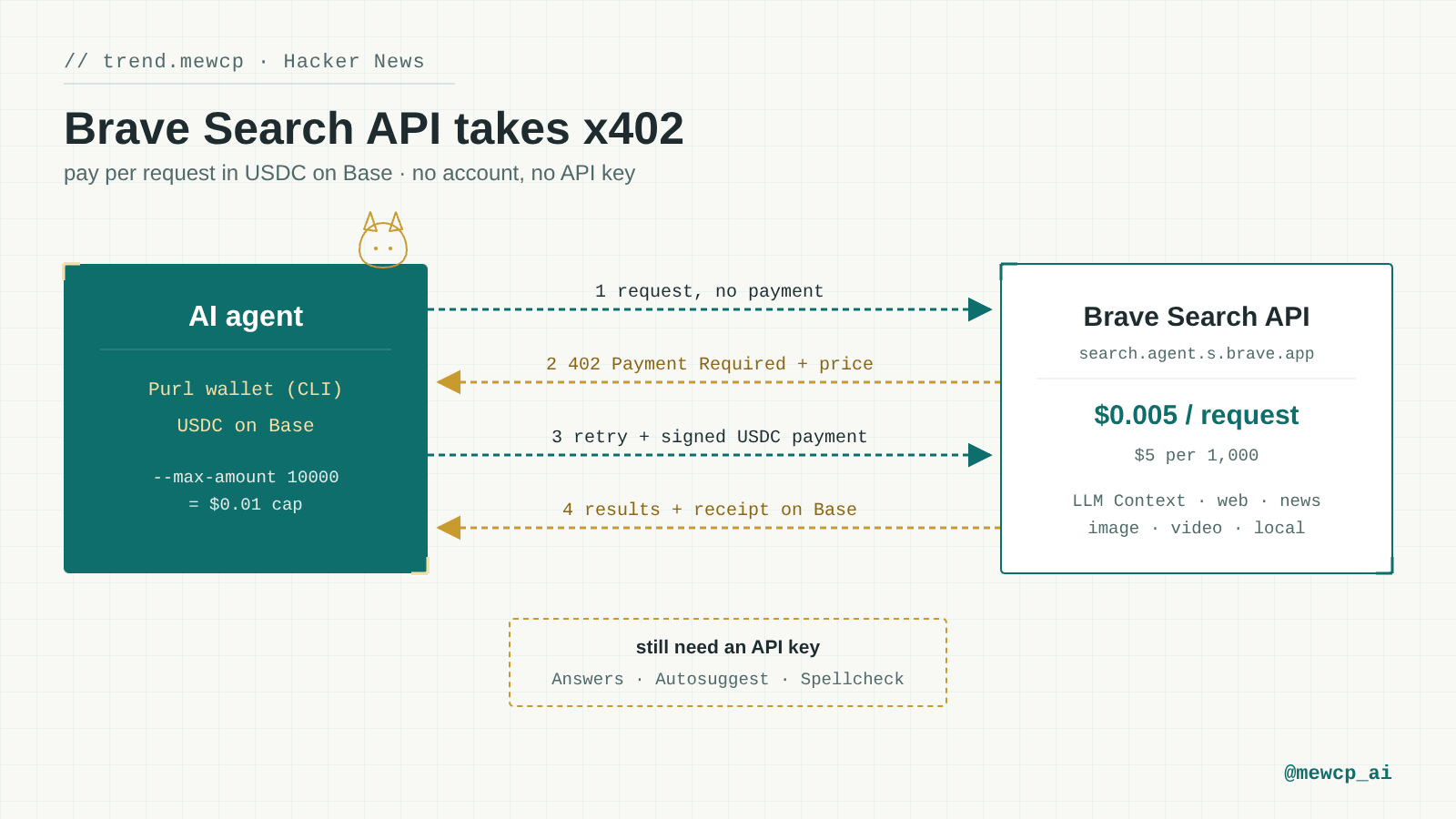
Here's the flow as Brave describes it. Your agent sends a search request with no payment attached. Brave answers with a 402 that states the price of that search and the payment details. The agent signs a USDC payment for that amount and retries with the signed payment attached. Once Brave verifies it, the search runs and the results come back with a receipt for the transaction on the Base blockchain.
So the signed payment is the credential. Brave runs its own facilitator accepting USDC on Base, and says other networks and stablecoins are "incoming soon".
Pricing follows Brave's published API rates. LLM Context, the endpoint built to give agents search context for grounding, costs $0.005 a request ($5 per 1,000). Web, news, image, video and local search cost the same. Gas fees on Base are covered for a limited time.
The docs fill in the practical bits. The paid service lives at https://search.agent.s.brave.app, with the same paths as api.search.brave.com and query parameters passed through unchanged. Web search, LLM Context, news, video, image and place search are sold this way. Answers, Autosuggest and Spellcheck aren't yet and still need an API key. Brave tells agents to read its llms.txt before paying, treats the 402 response as the authoritative price and publishes an openapi.json listing every paid path with its price.
The easiest client is Purl Wallet, a CLI wallet developed by Stripe. The docs example passes --max-amount 10000, which caps the payment in the token's base units, so 10000 is $0.01. That flag matters more than it looks, more on that below.
Why it matters if you build agents
Say you ship an agent that runs on a user's laptop and needs a handful of web searches per task. Today that means signing up, picking a plan, generating a key, storing it somewhere and hoping it never ends up in a log. With x402 it's fund a wallet, set a cap and go. One commenter on Hacker News said this is exactly why they use it. It's handy for agent web search because there's no login or account management, and all their local agents are set up that way now.
But you're trading one problem for another. Key management becomes wallet management. Someone in the same thread asked what people use to manage agent wallets, which is the right question. The --max-amount cap in the docs applies to that one request, and nothing in Brave's post covers a daily budget per agent.
And x402 only removes the key for these endpoints. Answers, Autosuggest and Spellcheck still need one, and the rest of your agent's apps still run on keys or OAuth. If you'd rather keep Brave on a normal key, MewCP has a Brave Search server with an LLM Context tool. The credential sits in an encrypted vault and gets attached at the moment of the call, so the model never sees it.
Cost is the other thing that changes. Per-request pricing turns your agent's search loop into a line item. One commenter worked it out: a basic ChatGPT session can easily run 30 web searches, which is already $0.15 at Brave's rate. If those calls go through a gateway you can at least count them. MewCP logs every call with the tool, the time, whether it worked and the latency, so an agent that searches 30 times for one answer is easy to spot.
What people are saying
The thread opened with a reality check. One commenter implemented x402 across a heavily crawled site and hasn't seen a single transaction, and said people on the x402 subreddit joke that the only ones paying are the ones testing whether it works. Others said scrapers have no reason to pay when they can scrape for free, and the advanced ones get past any anti-scraping measure anyway.
On the other side a commenter who runs a financial data service for agents over x402 said payments come through every now and then. Another said the real case is agents using credit-based SaaS without a subscription to each vendor, just a wallet with some allotment.
The credit card argument went back and forth. One side said cards are fine, just top up once per vendor. The reply was that per-vendor is the whole problem. That person said they're never going to pay in advance to use random websites, but wouldn't mind putting a dollar into a "browsing budget" for the day.
Price got a lot of airtime. Some called $5 per 1,000 expensive. Others said it's about average and listed what they pay elsewhere: Kagi at $12 per 1,000, Exa at $4 per 1,000, SerpApi at 5,000 searches for $75, and TinyFish as free. Those are commenters' numbers, we didn't check them.
One commenter also said they'd never take Brave seriously given its crypto history, which hints at who this will and won't reach.
Open questions
Adoption is the big one. Brave has a working paid endpoint now, but the thread had more stories of x402 sites with no buyers than buyers with stories.
Timing is fuzzy too. Other networks and stablecoins are "incoming soon" and gas is covered "for a limited time", with no dates for either.
And spending controls are still kinda DIY. A commenter predicted people will set policy limits and alerts per spending category, which sounds right, but neither Brave's post nor its docs say how. Until wallet tooling catches up, set the per-request cap and watch the call count.
Sources