Agweb is a WebKit browser for coding agents that never steals focus
by Rohit Gite, Co-Founder @MewCP6 min read
Keep reading
Keep reading
Agent infrastructure
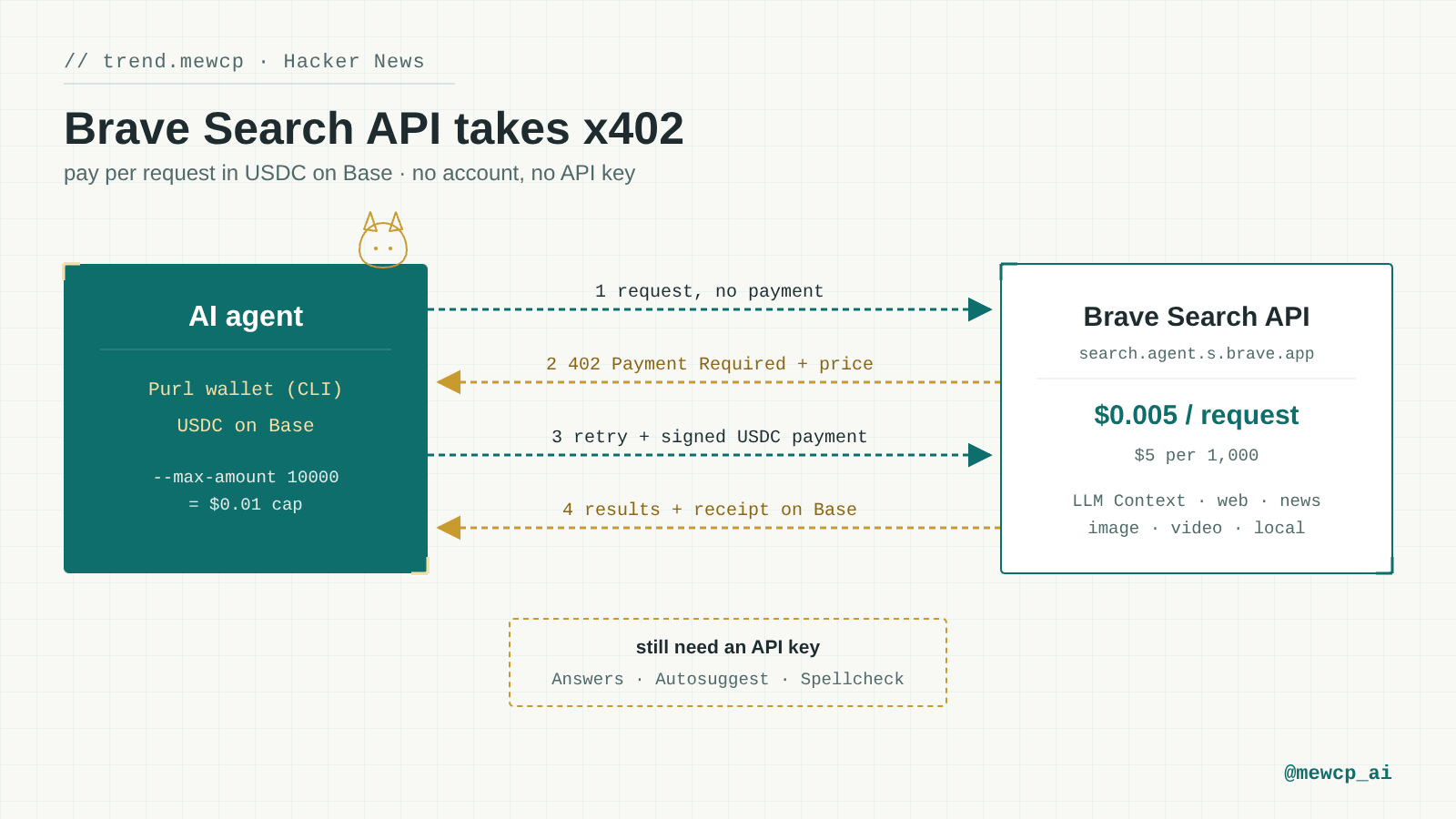
Brave now lets an agent pay $0.005 per search in USDC on Base instead of signing up for an API key. Hacker News argued over the price, the crypto rails and who will actually pay.
Agweb is a macOS browser built on WebKit that lets several coding agents drive tabs from the shell while you watch. Hacker News asked about CDP, Linux support and shared logins.
A developer got tired of Playwright's Chrome windows grabbing their keyboard, so they built a browser for agents that never comes to the front, and it landed on Hacker News today.
If you run more than one coding agent at a time you probably know the problem. One agent opens a Chrome window to test a login form and suddenly your keystrokes go into it. Go headless and some sites block you.
agweb is the author's answer. It's a macOS browser built on WebKit, Safari's engine, with an MIT license and the code on GitHub. The Show HN post reached 101 points and 30 comments, and the repo had 209 stars when we fetched it.
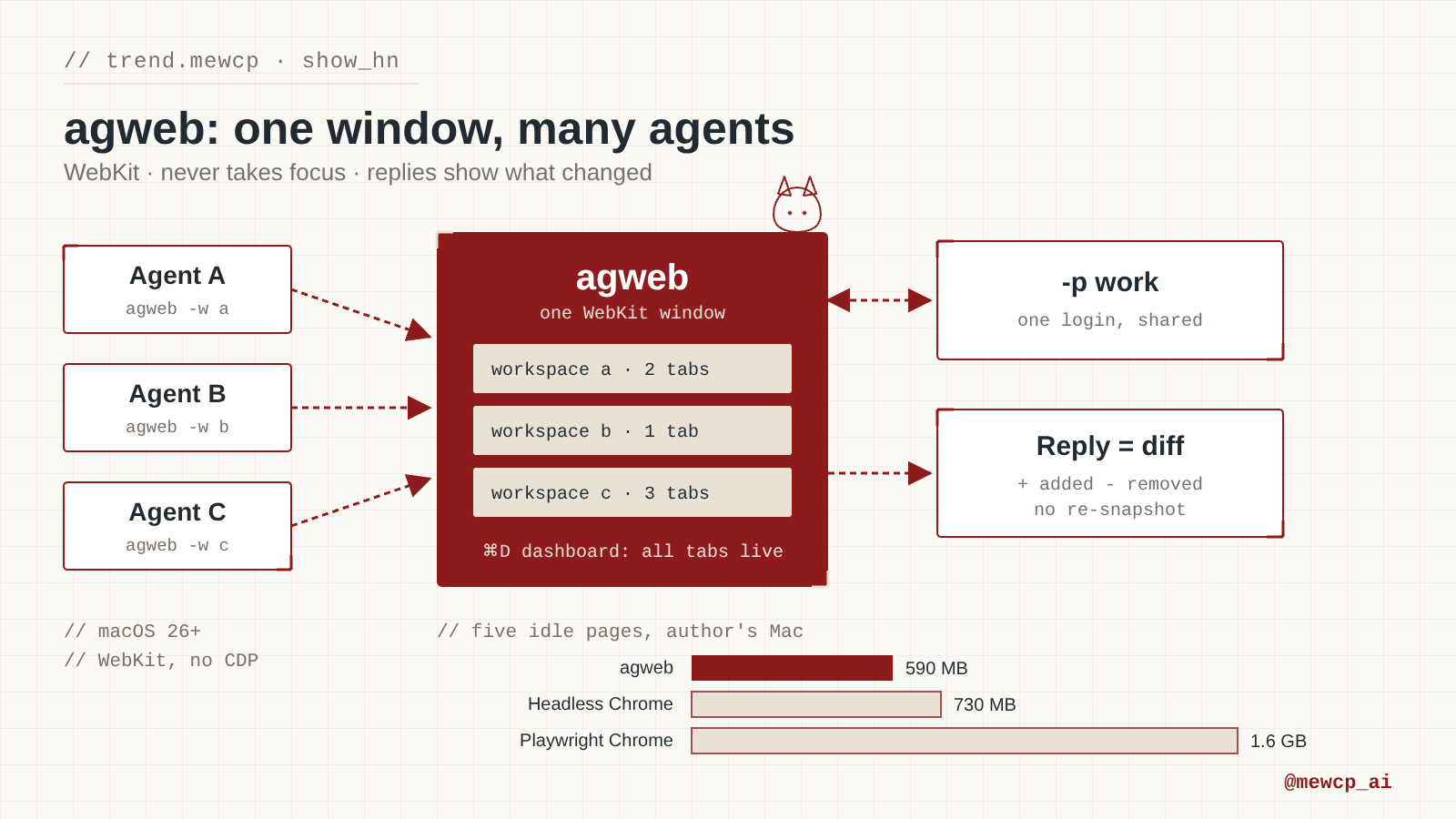
It's one window that never takes focus. Agents drive it from the shell with an agweb command that copies playwright-cli, and you watch all of them live. Each agent gets its own workspace with its own tabs, and a dashboard (⌘D) shows every tab of every agent at once along with each agent's last command. Dialogs, file pickers, tab changes and downloads get answered in code, so nothing pops up.
The part I think matters most for agents is how replies work. Click a button and the reply already says what changed: elements added or removed, fetches started, dialogs, popups, downloads, console errors. The README example shows a click on a "Main menu" button coming back as a small diff with the menu's new links in it. So the agent doesn't need to take a fresh snapshot after every step, which the author says means fewer tool calls and fewer tokens.
There's a bunch of other agent-friendly stuff:
ask hands a tab to you for a login, an MFA code or a CAPTCHA, without stealing focus.fill --secret-cmd 'pass show site' types a password the agent never sees in replies. 1Password and Bitwarden CLIs work too.-p work) keeps its logins and every agent on that profile can use it at the same time.Then there's resource use. On the author's Mac, five idle pages took 590 MB in agweb, 730 MB in headless Chrome and 1.6 GB in Playwright's Chrome. Idle tabs get throttled and then suspended, so those five pages sit at 0% CPU, where the author says Chrome's GPU process kept five to seven cores busy. That's one person's machine, not a benchmark.
Two things here are worth stealing even if you never install it.
The first is "tell me what changed". Say your agent is filling out a five-step signup flow. With a classic snapshot loop it pulls the whole accessibility tree after each click, and most of that tree is the same as last time. A diff reply sends only the new bits. If you're building any tool for agents, browser or not, returning the change instead of the full state is a cheap way to keep context small.
The second is keeping secrets out of the transcript. --secret-cmd means the password goes from your password manager to the page and the model never reads it. That's the right instinct, and it's the same idea behind keeping API keys out of agent configs. For the apps your agent reaches through an API instead of a browser tab, MewCP does that part: keys sit in an encrypted vault and get injected per call, so the agent never sees a key and has none to leak.
There's a real tradeoff in the shared profile though. Log in once and every agent can use that session, which is handy. But a commenter on Hacker News asked what happens when one agent logs out, switches accounts or trips a site's rate limit, since every other agent on that profile inherits it. The author said there's no fork option yet. For now you can state-save in one workspace and state-load in a fresh one to get an in-memory copy, so a logout stays in that copy, and a fork flag "can be done".
That's the browser version of a question API agents hit too: one shared login or one per agent, and what each agent is allowed to do with it. On the API side MewCP lets you pick which tools each agent can use, say read and send but not delete, and anything switched off gets stopped before it reaches the app. That doesn't replace a browser for sites with no API, which is where something like agweb comes in.
One commenter said they mostly test their own web apps, and focus hijacking during test cycles was a real pain. If that loop also involves logs and deploys, MewCP's debug your Vercel app workflow chains Vercel logs, a browser repro, a GitHub patch and a Supabase check into one prompt.
Mostly positive. One team said they use agweb daily as an alternative to Atlas, and another commenter plans to swap it in for Chrome in their verification flows.
The biggest pushback was CDP. agweb is the system WebKit, so there's no Chrome DevTools Protocol and Playwright and Chrome extensions can't attach. One commenter said it's "completely useless to me without CDP". The author's reply was short: if you need CDP, Playwright fits better.
Someone asked why build this when agent-browser.dev exists. Another commenter said agent-browser defaults to Chrome for Testing, which bot detection breaks, though its fans noted it can attach to a running Chrome too.
Asked why the ad blocker is on by default, the reply was less context for the AI, faster pages and less RAM. It leaves cookie consent dialogs alone, and a commenter explained that a lot of pages break when those get removed.
And the macOS 26 requirement lost some people. One commenter said they'd check back when someone sends a Linux PR, and the author said PRs are welcome.
Platform is the big one. It needs macOS 26 or later and builds with Xcode 26, so Linux CI and most servers are out for now. The ad blocker can't run uBlock's scripts, so YouTube ads and some "turn off your ad blocker" walls still get through. route only mocks fetch and XHR. And the memory and CPU numbers come from one Mac, so test with your own workload before you believe them. Whether it can pass as a normal browser to bot detection is open too, a commenter asked and the thread didn't answer.