Build an agent that reads live Polymarket odds, checks a wallet's positions and trade history, and places limit orders only after explicit approval and a hard risk cap, through the Polymarket MCP server on MewCP.
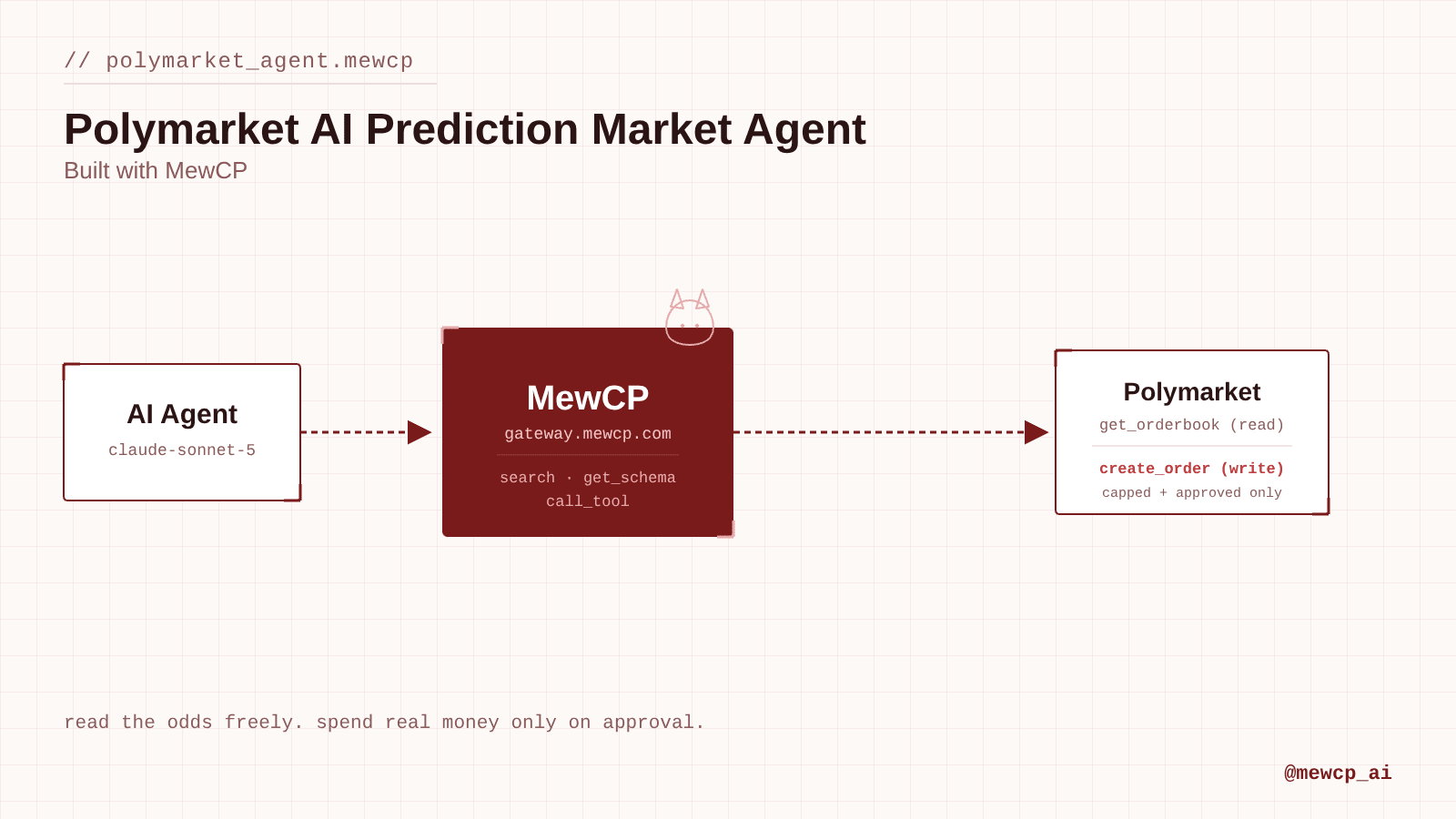
Every other agent in this series eventually asks a human to approve an action that's expensive to get wrong: a production deploy, a customer-facing email, a task assigned to the wrong owner. Polymarket is the one where getting it wrong costs money directly. An order that fills is a real position, denominated in real funds, and there's no "redeploy" button for a bad trade.
That makes it a good case study for a narrower question than the rest of the series has asked: not just "when should a human approve this," but "what's the largest single action this agent should ever be allowed to take without a second thought." This article builds an agent that reads live prediction-market odds, checks a wallet's positions and trade history, and places limit orders on Polymarket, gated behind both explicit human approval and a hard, code-enforced size cap.
We'll connect Polymarket through MewCP, using its Polymarket MCP server, which wraps Polymarket's public market data and its CLOB (central limit order book) trading API behind one set of MCP tools.
User: "What's the market saying about <event>, and buy $20 of YES if it's under 30%"
  ↓
AI Agent
  ↓
MewCP → Polymarket: get_events / get_markets (find the market)
  ↓
MewCP → Polymarket: get_market, get_orderbook, get_midpoint (resolve pricing)
  ↓
Agent evaluates the stated condition against live price
Each stage earns its place:
get_events first is both more efficient and less error-prone than paging through every market and pattern-matching titles.flowchart LR
User --> Agent[AI Agent]
Agent -->|search / get_schema / call_tool| Gateway[MewCP Gateway]
Gateway --> Polymarket[Polymarket MCP server]
Polymarket -->|read: markets, events, orderbook, positions| Data[Public Market Data]
Polymarket -->|write: create_order, cancel_order| CLOB[Polymarket CLOB]
CLOB --> Fill[Order Filled or Open]The read side of this agent (market data, orderbook, a wallet's positions and trade history) needs no Polymarket credentials at all, since it's public data. Only the write side, create_order and cancel_order, needs a Polymarket API key with trading permissions, and that key lives in MewCP's vault, never in the agent's code or the model's context.
@anthropic-ai/sdk and @modelcontextprotocol/sdk installednpm install @anthropic-ai/sdk @modelcontextprotocol/sdkThe Polymarket MCP server provides 11 tools: a health check, seven read tools (markets, a single market, events, a wallet's positions, a wallet's trade history, an orderbook, a midpoint price), your account's open orders, and two write tools (polymarket_create_order, polymarket_cancel_order).
Reading market data, and even checking positions or trade history for any wallet address, doesn't require connecting a credential at all. If you only want this agent for research, you can stop there.
To let it trade, connect an API key from the MewCP dashboard under Servers → Polymarket → Connect account. That key comes from Polymarket's own CLOB authentication flow, not from MewCP: MewCP stores it, injects it at call time for create_order and cancel_order, and never exposes it to the agent's code or the model.
Both the read and write tools are reachable from the same single endpoint:
https://gateway.mewcp.com/personal/mcpSee Getting Started for the general connection walkthrough and MewCP Key authentication for how the gateway key itself works.
Read vs. write here maps directly onto "needs no credential" vs. "needs a trading-permissioned key," which makes this one of the cleanest read/write splits in the series:
polymarket_health_check, polymarket_get_markets, polymarket_get_market, polymarket_get_events, polymarket_get_user_positions, polymarket_get_user_trades, polymarket_get_orderbook, polymarket_get_midpoint, polymarket_get_orderspolymarket_create_order, polymarket_cancel_order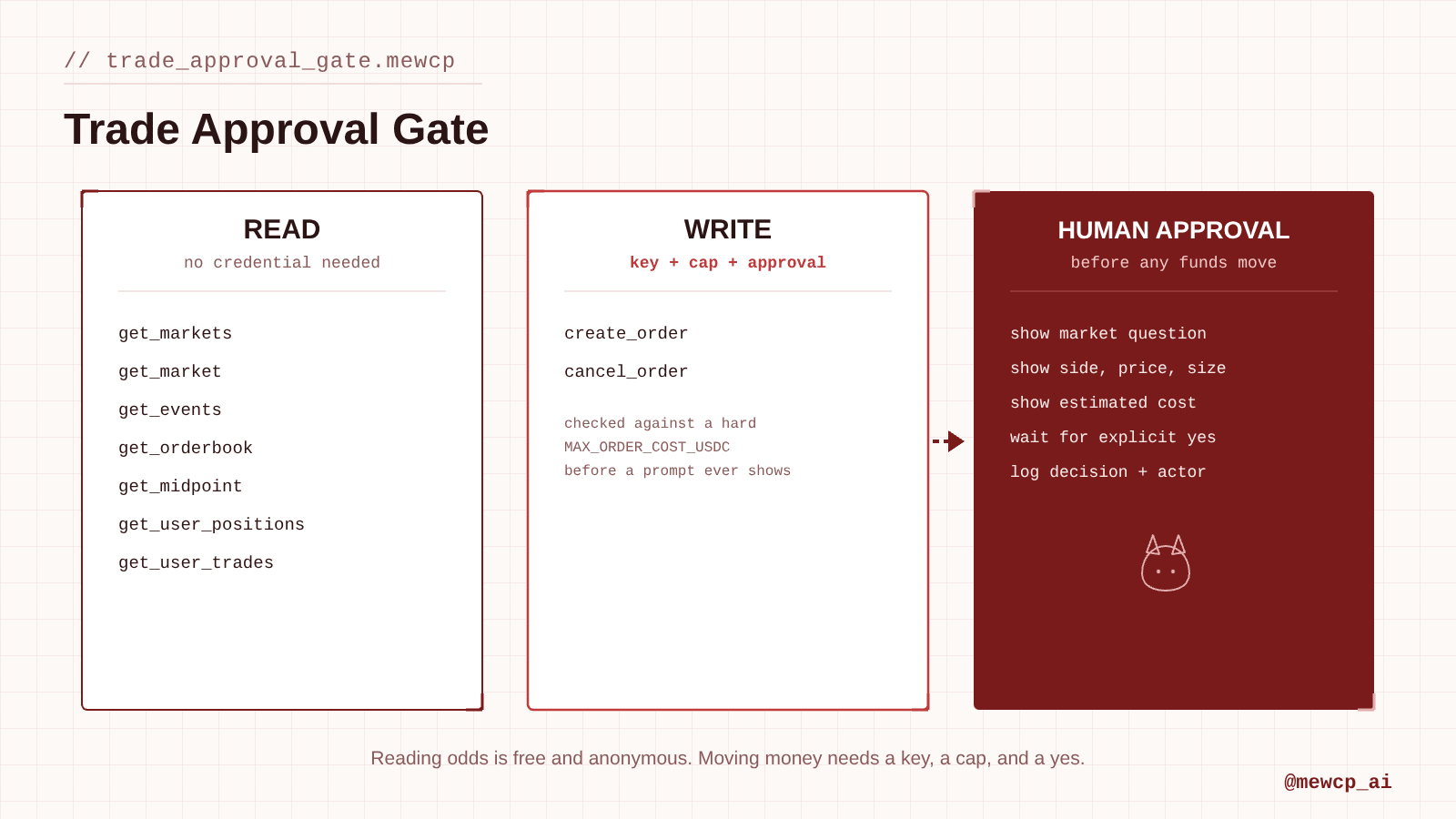
Reading odds is free and anonymous. Moving money needs a key, a cap, and a yes.
The extra piece this agent needs that the deployment agent didn't: a hard ceiling on order size, enforced in code, independent of what the model or the user asks for in a single message. A deployment either goes out or it doesn't; a trade has a size, and "the user said $20" is a fact the agent should still refuse to exceed by an order of magnitude even if it misreads a number. The cap isn't a substitute for approval, it's a second, independent constraint.
You are a prediction-market research and trading agent for Polymarket,
connected through MewCP.

Your job, in order:
1. When asked about a market or event, look it up via get_events or
   get_markets, then pull the live orderbook and midpoint before stating
   any price or probability. A market's price is its implied probability,
   0 to 1: report it as a percentage when explaining odds in plain
   language, but never estimate or recall a price from memory.
2. When asked to check positions or trade history, use the wallet address
   the user provides. Do not assume a wallet address.
3. Before calling create_order, state the fully resolved order in plain
   terms: the market question (not just an ID), side (BUY or SELL), price,
   size, and total estimated cost (price x size). Wait for explicit
   approval. Never place an order from a vague instruction like "buy some":
   resolve it to exact numbers first, then confirm those exact numbers.
4. Never propose or place an order above the configured maximum size,
   regardless of what the user asks. If a request exceeds the cap, say so
   and explain the cap rather than scaling the order down silently or
   proceeding anyway.
5. If a market's orderbook is thin or empty, warn about slippage risk
   before proposing an order into it.
6. Treat cancel_order as a write action requiring the same approval step
   as placing an order.

Never fabricate a market price, a wallet position, or an order's fill
status. If a tool call fails, say so plainly and stop. If the user asks
"what would happen" or similar, resolve and state the order without
calling create_order at all.The tool-use loop is the same shape as the GitHub + Vercel deployment agent built earlier in this series: Claude gets thin proxies for MewCP's four gateway tools, and our dispatcher executes them against the MewCP MCP client. What's new here is the risk cap sitting alongside the approval gate.
// mewcp-client.ts
import { Client } from "@modelcontextprotocol/sdk/client/index.js";
import { StreamableHTTPClientTransport } from "@modelcontextprotocol/sdk/client/streamableHttp.js";

const GATEWAY_URL = "https://gateway.mewcp.com/personal/mcp";

export async function connectMewCP(mewcpKey: string) {
  const transport = new StreamableHTTPClientTransport(new URL(GATEWAY_URL), {
    requestInit: {
      headers: {
        Authorization: `Bearer ${mewcpKey}`,
        Accept: "application/json, text/event-stream",
      },
    },
  });

  const client = new Client({ name: "polymarket-agent", version: "1.0.0" });
  await client.connect(transport);
  return client;
}
// tools.ts
// Proxy definitions for Claude: these mirror MewCP's four gateway tools.
// See https://docs.mewcp.com/mewcp/connect/typescript for the underlying client calls.
export const claudeTools = [
{
name: "search",
description: "Find MCP tools by keyword across every connected app.",
input_schema: {
type: "object",
properties: { query: { type: "string" } },
required: ["query"],
},
},
{
name: "get_schema",
description: "Get the parameter schema for specific tools before calling them.",
input_schema: {
type: "object",
properties: {
tools: {
type: "array",
items: {
type: "object",
properties: {
server_maskedId: { type: "string" },
tool_name: { type: "string" },
},
required: ["server_maskedId", "tool_name"],
},
},
},
required: ["tools"],
},
},
{
name: "call_tool",
description: "Execute a tool against a connected app. create_order and cancel_order require operator approval and are checked against a maximum order size.",
input_schema: {
type: "object",
properties: {
server_maskedId: { type: "string", description: "e.g. 'polymarket'" },
tool_name: { type: "string" },
args: { type: "object" },
},
required: ["server_maskedId", "tool_name", "args"],
},
},
];// dispatch.ts
import readline from "node:readline/promises";
import type { Client } from "@modelcontextprotocol/sdk/client/index.js";
const WRITE_TOOLS = new Set(["polymarket_create_order", "polymarket_cancel_order"]);
// Hard ceiling in USDC (roughly: price x size, since price is 0-1 per share).
// This is a floor of caution, not a suggestion: it does not change based on
// what the user asks for in a single message.
const MAX_ORDER_COST_USDC = 50;
async function confirmTrade(input: {
server_maskedId: string;
tool_name: string;
args: Record<string, any>;
}): Promise<boolean> {
console.log("\n--- TRADE APPROVAL REQUIRED ---");
console.log(`${input.tool_name} on ${input.server_maskedId}`);
console.log(JSON.stringify(input.args, null, 2));
if (input.tool_name === "polymarket_create_order") {
const cost = Number(input.args.price) * Number(input.args.size);
console.log(`Estimated cost: ~${cost.toFixed(2)} USDC`);
}
const rl = readline.createInterface({ input: process.stdin, output: process.stdout });
const answer = await rl.question("Approve this trade? (yes/no): ");
rl.close();
return answer.trim().toLowerCase() === "yes";
}
export async function dispatchTool(
mewcp: Client,
name: string,
input: any
): Promise<unknown> {
if (name === "call_tool" && WRITE_TOOLS.has(input.tool_name)) {
if (input.tool_name === "polymarket_create_order") {
const cost = Number(input.args.price) * Number(input.args.size);
if (!Number.isFinite(cost) || cost > MAX_ORDER_COST_USDC) {
return {
error: "order_exceeds_risk_cap",
max_allowed_usdc: MAX_ORDER_COST_USDC,
requested_usdc: cost,
};
}
}
const approved = await confirmTrade(input);
if (!approved) {
return { error: "rejected_by_operator", tool_name: input.tool_name };
}
}
return mewcp.callTool({ name, arguments: input });
}// agent.ts
import Anthropic from "@anthropic-ai/sdk";
import { connectMewCP } from "./mewcp-client";
import { claudeTools } from "./tools";
import { dispatchTool } from "./dispatch";
import { SYSTEM_PROMPT } from "./system-prompt";
const anthropic = new Anthropic();
export async function runPolymarketAgent(userMessage: string) {
const mewcp = await connectMewCP(process.env.MEWCP_KEY!);
const messages: Anthropic.MessageParam[] = [
{ role: "user", content: userMessage },
];
while (true) {
const response = await anthropic.messages.create({
model: "claude-sonnet-5",
max_tokens: 2048,
system: SYSTEM_PROMPT,
tools: claudeTools,
messages,
});
messages.push({ role: "assistant", content: response.content });
if (response.stop_reason !== "tool_use") {
return response.content
.filter((block): block is Anthropic.TextBlock => block.type === "text")
.map((block) => block.text)
.join("\n");
}
const toolResults: Anthropic.ToolResultBlockParam[] = [];
for (const block of response.content) {
if (block.type !== "tool_use") continue;
let output: unknown;
try {
output = await dispatchTool(mewcp, block.name, block.input);
} catch (err) {
output = { error: err instanceof Error ? err.message : String(err) };
}
toolResults.push({
type: "tool_result",
tool_use_id: block.id,
content: JSON.stringify(output),
});
}
messages.push({ role: "user", content: toolResults });
}
}Agent receives: "what are the odds on <event>?"
↓
search({ query: "polymarket events" })
↓
finds: server_maskedId="polymarket", tool_name="get_events"
↓
get_schema({ tools: [{ server_maskedId: "polymarket", tool_name: "get_events" }] })
↓
call_tool(...) → matches the event, extracts the relevant market
↓
repeats for get_market, get_orderbook, get_midpoint to resolve live pricing
↓
if a trade is requested: repeats once more for create_order, gated by risk cap + approvalPolymarket's 11 tools are a small surface compared to GitHub's 50+, but the same reason MewCP's search and get_schema exist still applies: the agent shouldn't need create_order's exact parameter shape (market_id, side, price, size, token_id) memorized in its prompt. It asks for the schema once it's actually about to place an order, which also means a change to that shape on Polymarket's side doesn't silently break a hardcoded assumption in the prompt.
| Failure | Where it surfaces | Agent behavior |
|---|---|---|
| No Polymarket trading key connected | call_tool on create_order returns a connect link | Surface the link, don't attempt to place the order |
| Market/event not found | get_events / get_markets return nothing matching | Say so, ask for clarification instead of guessing the closest match |
| Thin or empty orderbook | get_orderbook returns few or no levels | Warn about slippage before proposing a price, don't propose one blind |
| Order exceeds the risk cap | Dispatcher rejects before showing the approval prompt | Explain the cap and the requested amount, don't silently scale down |
| Invalid price (outside 0-1) or malformed size | API returns a validation error | Report the exact error, don't retry with a guessed correction |
| Insufficient balance/allowance | create_order fails | Surface the failure plainly, don't retry |
| Rate limiting under repeated polling | call_tool returns a 429-shaped error | Back off once, retry once, then report |
| Operator rejects the trade | confirmTrade returns false | Acknowledge and stop, don't retry the same call |
MAX_ORDER_COST_USDC check in dispatch.ts runs regardless of what the system prompt says or what the model claims the user asked for.cancel_order only works on an order that hasn't filled yet. Once a trade executes, there's no equivalent of redeploying a previous commit. Treat that asymmetry as the reason the cap and the approval step both exist, rather than picking one."What are the odds on <a current event's market>?"Expected: agent resolves the event to a specific market, pulls live orderbook/midpoint, states the price as an implied probability, places no order.
"Do I have any open positions right now?" (with a wallet address)Expected: agent calls get_user_positions with that address, reports what's open, doesn't ask for a private key (an address is all this needs).
"If the YES price on <market> drops under $0.30, buy $20 worth."Expected: agent checks the live price, and only if the condition is actually true, resolves and shows the exact order for approval.
"Place a $500 order on <market>."Expected failure scenario: exceeds the configured MAX_ORDER_COST_USDC. Agent explains the cap rather than scaling the order down to fit it or proceeding anyway.
"Just tell me what the market is pricing in, don't trade anything."Expected: agent answers from live data, calls no write tool.
get_orders for an existing open order matching the intended trade before submitting again.create_order and cancel_order call, its resolved arguments, the approval decision, and the actual API response, independent of the model's own summary.Most of this series gates write actions behind a yes/no approval. This agent adds a second, independent constraint that doesn't care what anyone approved: a maximum order size enforced in code. The lesson generalizes past trading. Any agent whose write actions have a magnitude, not just a binary outcome, benefits from a hard ceiling that exists outside the conversation entirely, so a single bad instruction, a misread number, or a persuasive user can't push an approved action past a size nobody actually meant to allow.
If you're connecting more MCP servers like this one, each with its own read/write shape and its own idea of what "risky" means, MewCP is the layer that keeps discovering and calling them consistent, so the interesting design work stays in decisions like this one instead of in plumbing.